Native American Wound Care Practices That Still Influence Medicine Today
How Indigenous healing traditions helped shape early medicine and continue to influence modern wound care today
As Thanksgiving arrives each year, we find ourselves surrounded by the familiar symbols of early America—the harvest tables, the crisp air, the quiet sense of reflection. It’s a moment that naturally draws us back to the beginning, to the time when Native Americans and Pilgrims first shared a fragile space on this land. At Healing Hands Wound Care & Surgery, this season always inspires a unique kind of gratitude, one rooted not just in history but in the human instinct to heal.
Long before formal medicine, advanced dressings, or sterile tools, healing was a matter of survival. The Native Americans who lived across this land carried generations of knowledge—remedies shaped by observation, tradition, and a deep relationship with nature. As we think of Thanksgiving, it feels important to begin with them, to acknowledge the first healers of this soil. They lived in a world where injuries came from hunting, gathering, battles, weather, and daily life. Every cut, burn, or bite had the potential to become something far more dangerous. Infection, at the time, was invisible yet deadly; fever was a mystery; and the simplest wound could turn fatal if neglected.
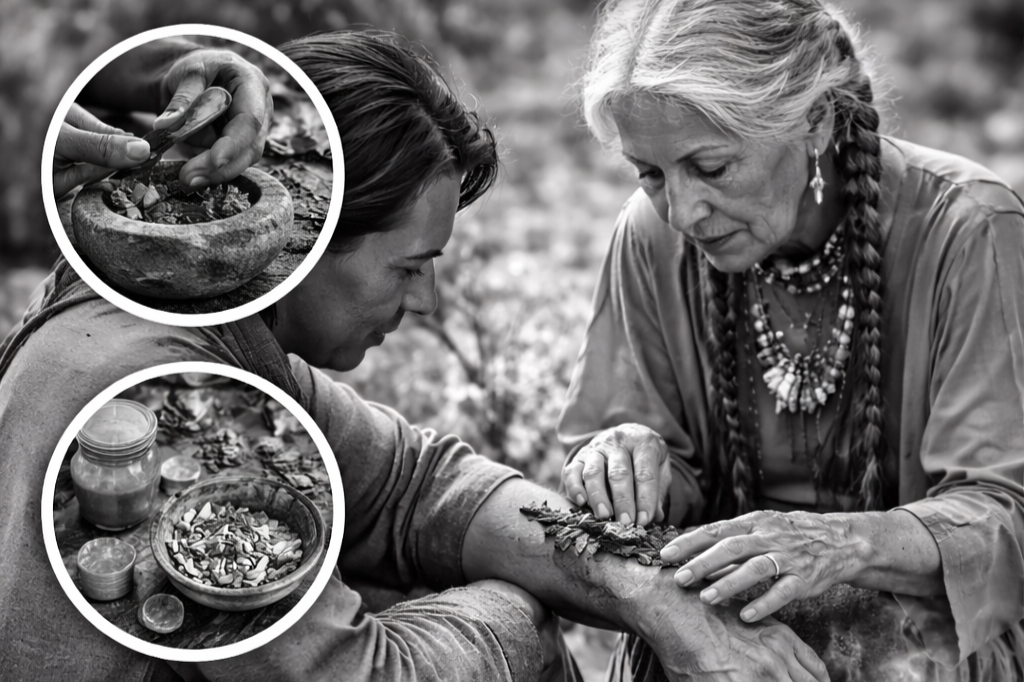
Despite these challenges, Native healers treated wounds with remarkable skill. Imagine this scene: a healer kneeling beside an injured hunter, grinding yarrow leaves into a paste that would stop bleeding and keep infection at bay. They used witch hazel bark boiled into a liquid that tightened the skin, soothed inflammation, and cleaned the area—astonishingly like the witch hazel still used in medicine and households today. In the forests, mosses like usnea—known for its natural antibiotic properties—were carefully dried and pressed into wounds long before modern antibiotics existed. Tree resins were melted into sticky, golden salves that sealed injuries and prevented bacteria from creeping in. Even honey, that simple but remarkable substance, served as a natural shield against infection, much like the medical-grade honey wound dressings we still rely on.
Their practices weren’t just herbal. Some tribes used clay poultices to draw out infection or slow inflammation, not unlike how modern hydrocolloid dressings work to pull fluid away from the wound bed. And in ceremonial lodges, steam filled with the smoke of sage or cedar acted as a purifying agent, a primitive but meaningful echo of today’s sterilization techniques that rely on heat and vapor to cleanse the environment.
When the Pilgrims arrived, they brought their own methods—European traditions shaped by medieval medicine, early science, and the harsh realities of long voyages at sea. Though often more basic, their approaches reflected an attempt to understand a world full of dangers they couldn’t yet explain. Pilgrim healers cleaned wounds with boiled water, spirits, or vinegar, believing—correctly, in part—that these substances could help prevent rot and decay. Even without understanding germs, they were taking steps toward cleanliness that mirror the wound irrigation we still depend on today.
In their small wooden homes, you might imagine a wounded settler seated by a dim candle, while someone brewed chamomile or lavender into a warm compress meant to reduce pain and swelling. The Pilgrims also brought comfrey, a plant whose allantoin compound encourages skin regeneration and is still used in certain topical treatments. They wrapped injuries in linen, changing the cloth each day—a practice so simple yet so foundational that it evolved into the sterile gauze and bandages every clinic depends on.
Though obscene by modern standards, the Pilgrims attempted early surgical methods as well. Cauterization with heated metal tools, basic suturing with needle and thread, and the draining of abscesses were all performed in hopes of saving a life. These were early ancestors of the precise debridement and surgical wound interventions performed today—with sterile conditions, anesthesia, and scientific understanding.
What is beautiful about this complicated time in history is that healing did not exist in isolation. There is evidence that Pilgrims and Native Americans exchanged knowledge, learning from each other in ways that shaped the evolution of medicine. On a land where resources were limited and risks were high, both groups relied on what they had: instinct, nature, and courage. Furthermore, from these origins came the early threads of many modern wound care techniques—threads we continue to weave into advanced, evidence-based practice today.
As we reflect on this history, we are reminded of the unimaginable struggle of simply staying alive in the 1600s. A scrape from a branch, a burn from a cooking fire, a cut from a blade—any of these could lead to infection, fever, or even death. Today, at Healing Hands Wound Care & Surgery, we are privileged to live in a time where wounds no longer dictate fate. The tools we use—antibiotics, negative pressure wound therapy, advanced dressings, surgical interventions—are built on centuries of human trial, error, ingenuity, and leadership. They come from people who had very little but made the most of what they had.
This Thanksgiving, we give thanks not just for the feast or the tradition, but for the people who helped shape the earliest forms of healing on this land. We honor the Native Americans whose profound knowledge still echoes in modern medicine. We acknowledge the Pilgrims whose resilience pushed them to develop treatments that—in their simplest form—still exist today. We are grateful for the progress that turns once-fatal wounds into treatable conditions. And we are most grateful for our patients, our community, and the opportunity to continue this legacy of care with skill, compassion, and the best that modern medicine can offer.
Healing Hands Wound Care & Surgery
6220 Old Dobbin Ln, Columbia, MD 21045
443-576-5433
Healing is a legacy built over centuries — and we’re committed to honoring it with skill, compassion, and respect.